

Aurél
Prósz
I build frontier AI systems for the life sciences, amplifying researchers and helping humanity confront its deadliest diseases.
View CV





Experience
PrószPhD
I build and deploy AI systems that solve scientific problems, backed by 8+ years of industry experience.
I started in physics and biosensing, moved into computational cancer research, and now develop AI models and agents for scientific discovery. My work spans interpretable neural architectures, LLM evaluation, and turning biological predictions into experimentally testable hypotheses.
As a two-time founder, I take systems from research and product architecture through deployment and operation. At PharosBio, I lead multiple AI researchers and engineers, with responsibility for the research roadmap, hiring, and technical delivery.
- Application engineering
- Python and Rust for scientific workflows and user-facing AI applications. At Chimera Solutions, I built Menta and have kept its RAG service running for 10,000+ users over 2+ years.
- Cloud deployment
- Hosting and managing applications on AWS and Microsoft Azure, with hands-on ownership of deployment and ongoing operation.
- LLM infrastructure
- Deploying and scaling open-weight models on Gefion, Denmark's AI supercomputer, including inference for LLMsynthlet and hosting frontier models such as GLM-5.2.
I co-founded PharosBio and lead its research roadmap, product architecture, and technical strategy, turning scientific ideas into working AI systems for research and drug discovery.
- Lead an interdisciplinary team of four across AI engineering, computational biology, research, and product development, with responsibility for hiring and performance management.
- Direct development of Hydra, connecting approximately 100 scientific databases and 200+ codified skills into workflows that plan, run, and check analyses.
- Translate research into prototypes, demonstrations, and partnership discussions. As co-founder, successfully raised $150K+ in equity funding.
Computational work in cancer genomics, DNA-repair deficiency, multimodal biomarkers, and language-model reasoning in biology, supported by $2M+ in grant funding.
- Developed interpretable machine-learning approaches for biological aging and translational oncology, working with international academic and clinical collaborators.
Founded an applied AI consultancy and delivered systems across education, legal technology, scientific research, environmental sensing, and computer vision.
- Created, deployed, and hosted Menta, an educational RAG application serving 10,000+ users reliably for more than two years.
- Built domain-specific legal retrieval and search, plus a phone-camera system for reconstructing 3D point clouds for environmental sensing.
Studied genomic aberration profiles and the mechanisms behind cancer-associated DNA-repair pathway deficiencies, including an external stay at Dana-Farber Cancer Institute.
View profileI joined Turbine.AI as employee #2 and integrated the mutational layer into its core simulated-cell AI product for cancer research and drug discovery.
- Worked with AI engineers and PhD-level biologists on biological simulation, research strategy, and early company building, contributing through more than four funding rounds and a valuation above $150M.
- Developed statistical methods for comparing in vitro experiments with in silico simulations, using R and Python for clustering, principal component analysis, logistic regression, and visualization.



 Harvard Medical School
 Chimera Solutions
Selected
projects
Click a project to see what it does, the scale of the work, and the underlying paper or repository.
All repositoriesHydra
I lead the technical development of Hydra, a scientific analysis platform that plans work, runs tools and databases, and checks its own results.
- ~100 scientific databases
- 200+ codified skills
- analysis from a single prompt
Research to product
I translate scientific research needs into the roadmap, architecture, and working prototypes for an automated-scientist platform.
Agent workflows
Hydra combines planning, scientific tools, database access, and result checking to carry out complex analyses from a research question.
Technical leadership
I lead a team of four across AI engineering and computational biology, connecting research priorities with product development and technical delivery.
LLMsynthlet
Can open-weight LLMs reason about cancer vulnerabilities without task-specific training? I evaluated their predictions against genome-wide CRISPR screens, then scaled the approach to search for new synthetic-lethal gene interactions.
- 398,277 gene pairs screened
- 0.715 benchmark AUROC
- Qwen2.5-32B-Instruct
My contribution
As first author, I evaluated zero-shot biological reasoning and deployed and scaled the models on Gefion for a large in silico screen.
Evaluation & findings
The study compared model sizes and added biological context against CRISPR-screen results. Qwen2.5-32B-Instruct offered the best cost-quality tradeoff; added pathway and cell-line context did not consistently help.
What the results mean
The released scores and rationales prioritize gene pairs for follow-up. The 0.715 AUROC comes from the benchmark; predictions from the larger screen remain hypotheses requiring experimental validation.
Epigenetic clocks
I developed XAI-AGE, a biologically informed neural network architecture for predicting biological age from DNA methylation, with interpretable links to biological pathways.
- XAI-AGE architecture
- first-author paper
- Scientific Reports · 2024
Research question
How can a model estimate biological age while helping researchers understand the biology behind its predictions?
Original model development
I developed XAI-AGE to incorporate biological knowledge into the neural network architecture and make age prediction from methylation data interpretable.
Scientific contribution
The work connects deep learning with biological interpretation, giving researchers a way to investigate which pathways contribute to the age estimate. Published as a first-author study in Scientific Reports.
Menta
I created, deployed, and hosted this production RAG system, serving more than 10,000 users reliably for over two years.
- 10,000+ users served
- 2+ years in production
- reliable RAG deployment
The application
An educational AI application built around retrieval-augmented generation, combining knowledge retrieval with language-model responses.
End-to-end ownership
Through Chimera Solutions, I took the system from development to deployment and hosting, with responsibility for keeping it running for its users.
Production track record
More than 10,000 users served over two years without outages. The project demonstrates sustained ownership of a working AI service beyond the initial prototype.
My research in AI and life sciences
Unconstrained generation of synthetic antibody–antigen structures to guide machine learning methodology for antibody specificity prediction
Nature Computational Science2026Zero-shot biological reasoning with open-weights large language models reproduces CRISPR screen based prediction of synthetic lethal interactions
bioRxiv2024Biologically informed deep learning for explainable epigenetic clocks
Scientific Reports2023Nucleotide excision repair deficiency is a targetable therapeutic vulnerability in clear cell renal cell carcinoma
Scientific ReportsAchievements
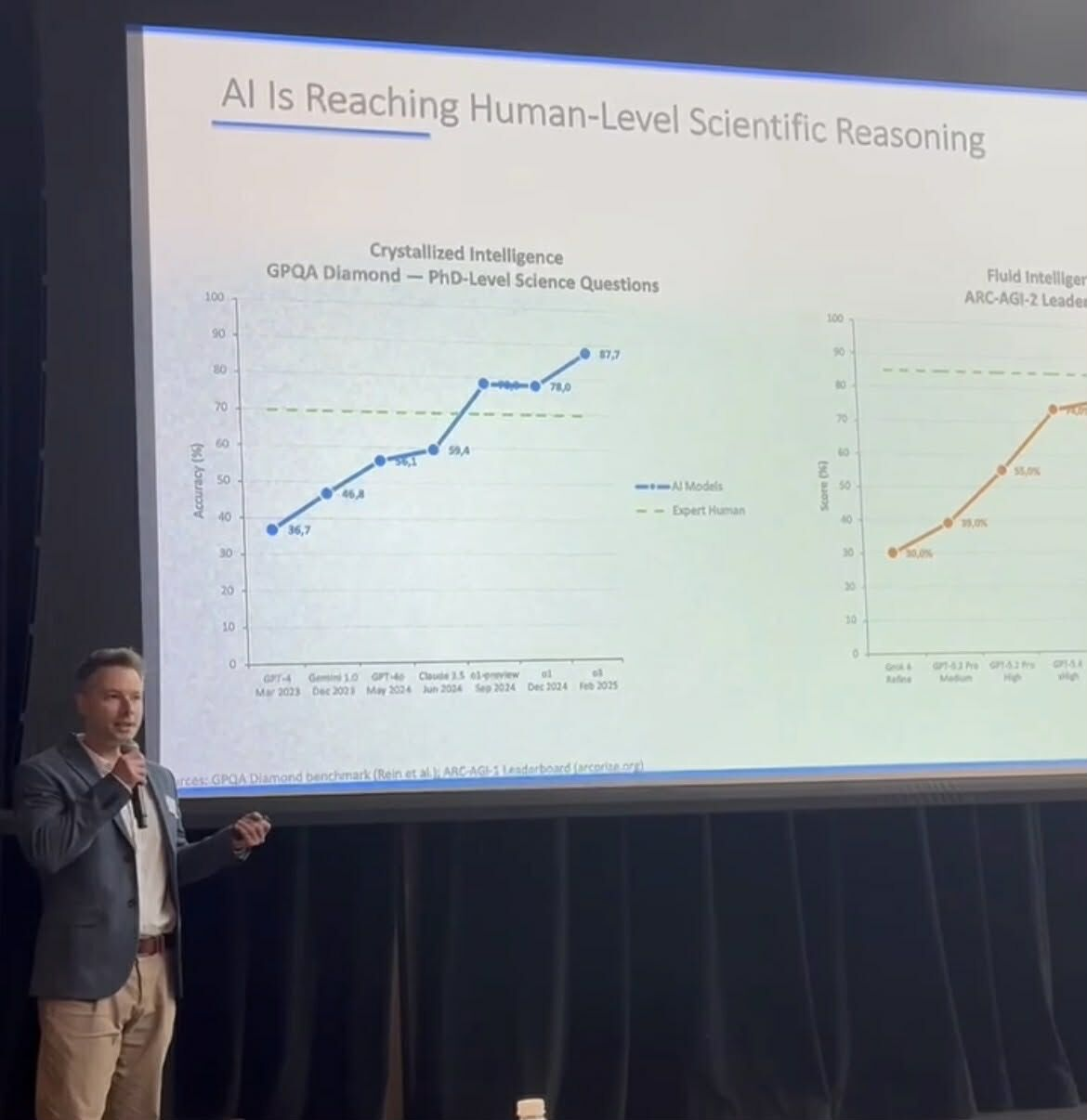
Three hackathon wins and more than five conference talks and posters across Europe and the USA.
Hackathon wins
Conference talks
and posters
 View event
 Most recent conference talk · Boston, USA
AI Health Frontiers 2026
Check out my latest writing about technology and AI
Following the signal through the noise in AI, from frontier models to the systems changing how research gets done.
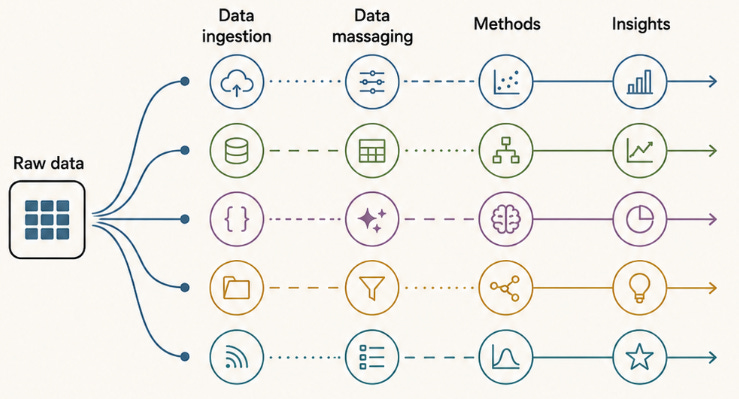
The new data science question: What should AI be allowed to change?
When every dataset can become a hundred analyses, control matters as much as creativity.
Read article
Vibe Coding with AI in Minutes
How to build simple apps with AI to make your work easier, or just because why not?
Read article
From biological sequences to scientific discovery
Introducing the artificial intelligence models that will drive scientific discovery in the future.
Read article